Special thanks to Jihoon Song and Sina Mahmoodi for the review and feedback. ❤️
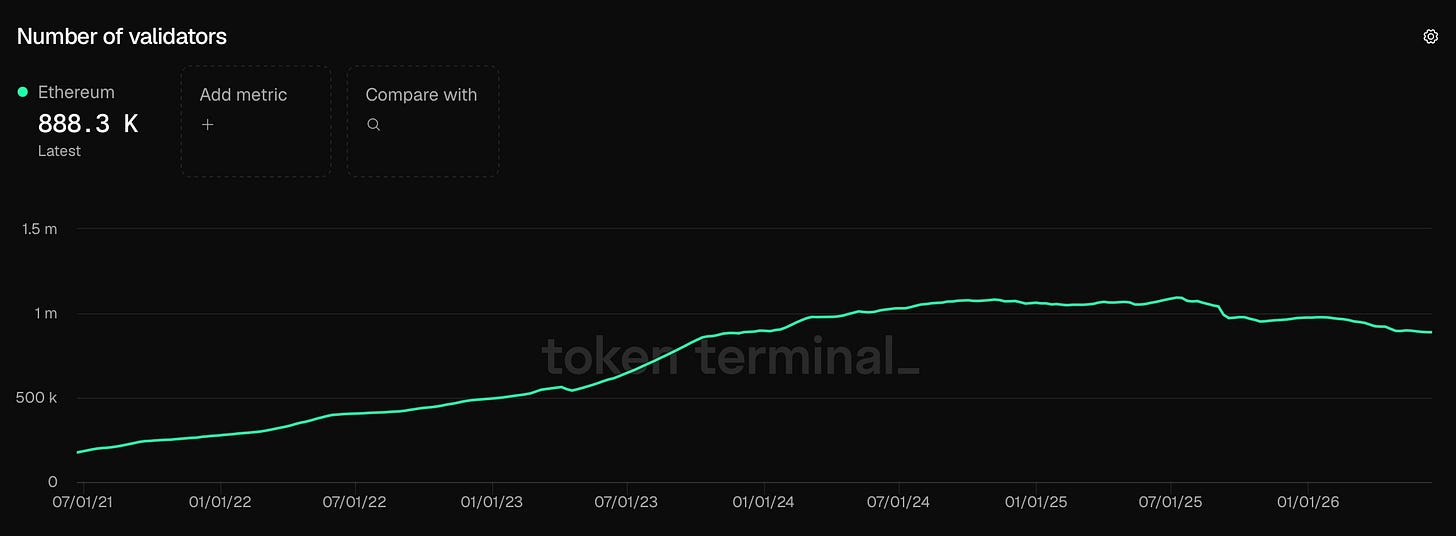
Ethereum has ~888.3k validators globally, one of the most distributed consensus layers in crypto. But a decentralized validator set doesn’t guarantee decentralized block production. FOCIL is Ethereum’s attempt to close that gap.
The Structural Tension
Under PBS (Proposer-Builder Separation), most blocks are constructed by specialized block builders rather than validators. Builders compete to maximize MEV and block value, which can lead to concentration pressures in the block construction market.
This creates a structural separation:
Validators secure consensus and select blocks
Builders construct and order transactions within blocks
While efficient, this separation has introduced significant centralization in block production - builder market share is far more concentrated than the validator set itself.
A Real-World Stress Test
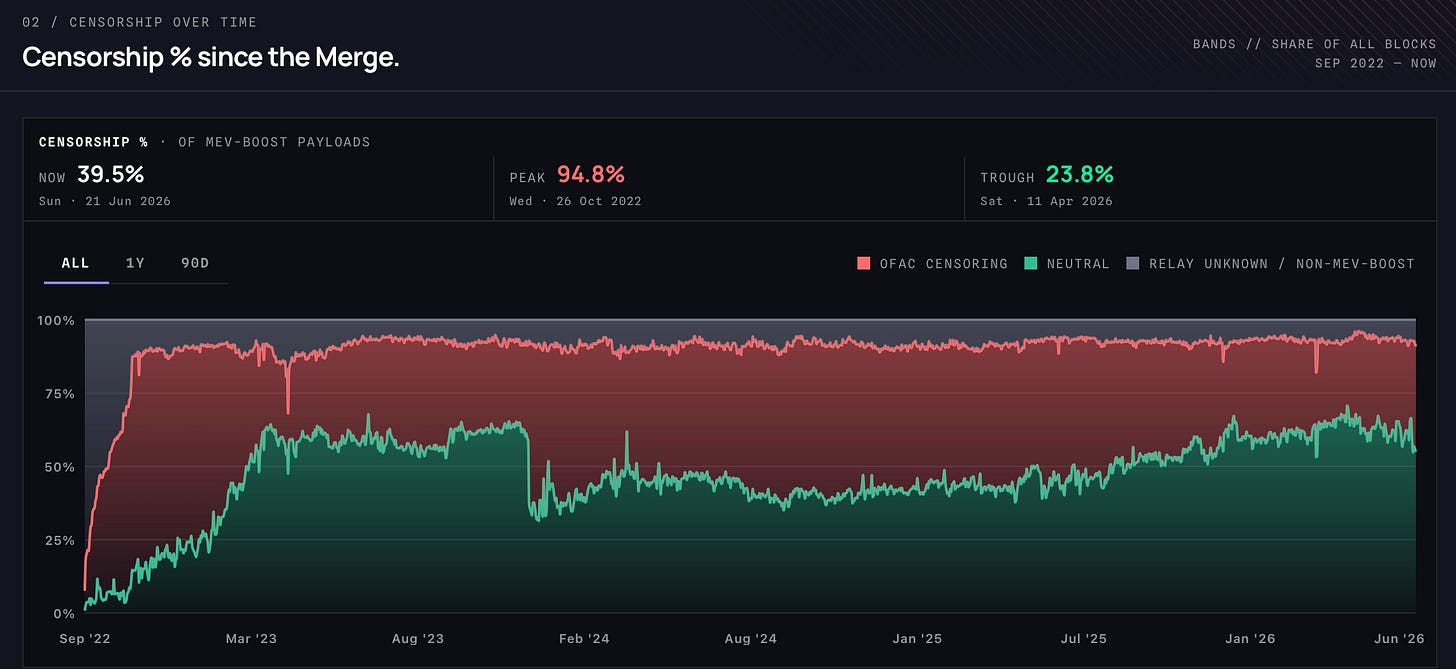
In August 2022, the U.S. Treasury sanctioned Tornado Cash. Shortly afterward, major builders began filtering associated transactions.
At peak, a large share of Ethereum blocks were produced through OFAC-compliant block-building pipelines.
The validator set was decentralized. The inclusion decision was not. The internal policy of a handful of companies effectively became the network’s inclusion policy. That became a wake-up call for Ethereum researchers.
The Core Idea Behind FOCIL
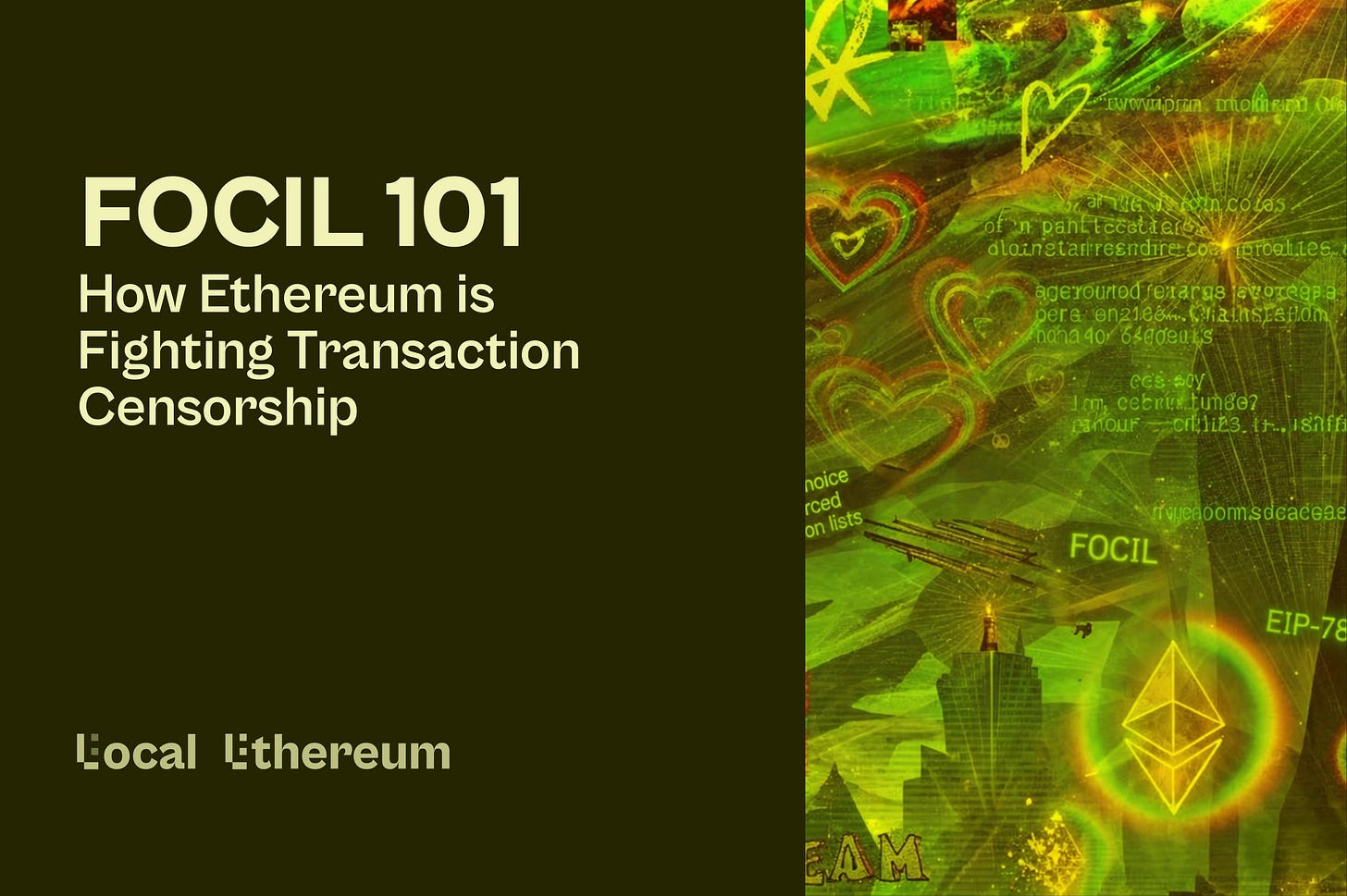
FOCIL is based on a simple principle: inclusion should be supported by protocol-level guarantees, rather than relying solely on builder discretion.
Today a few firms build most blocks, so a valid transaction can be dropped based on what they’re willing, or legally allowed to include.
FOCIL introduces a rotating committee of validators each slot. These validators independently observe the mempool and create inclusion lists of valid transactions they believe should be included.
Block builders are then required to respect these inclusion constraints when constructing blocks, or risk their blocks being rejected via fork-choice rules.
How It Changes the System
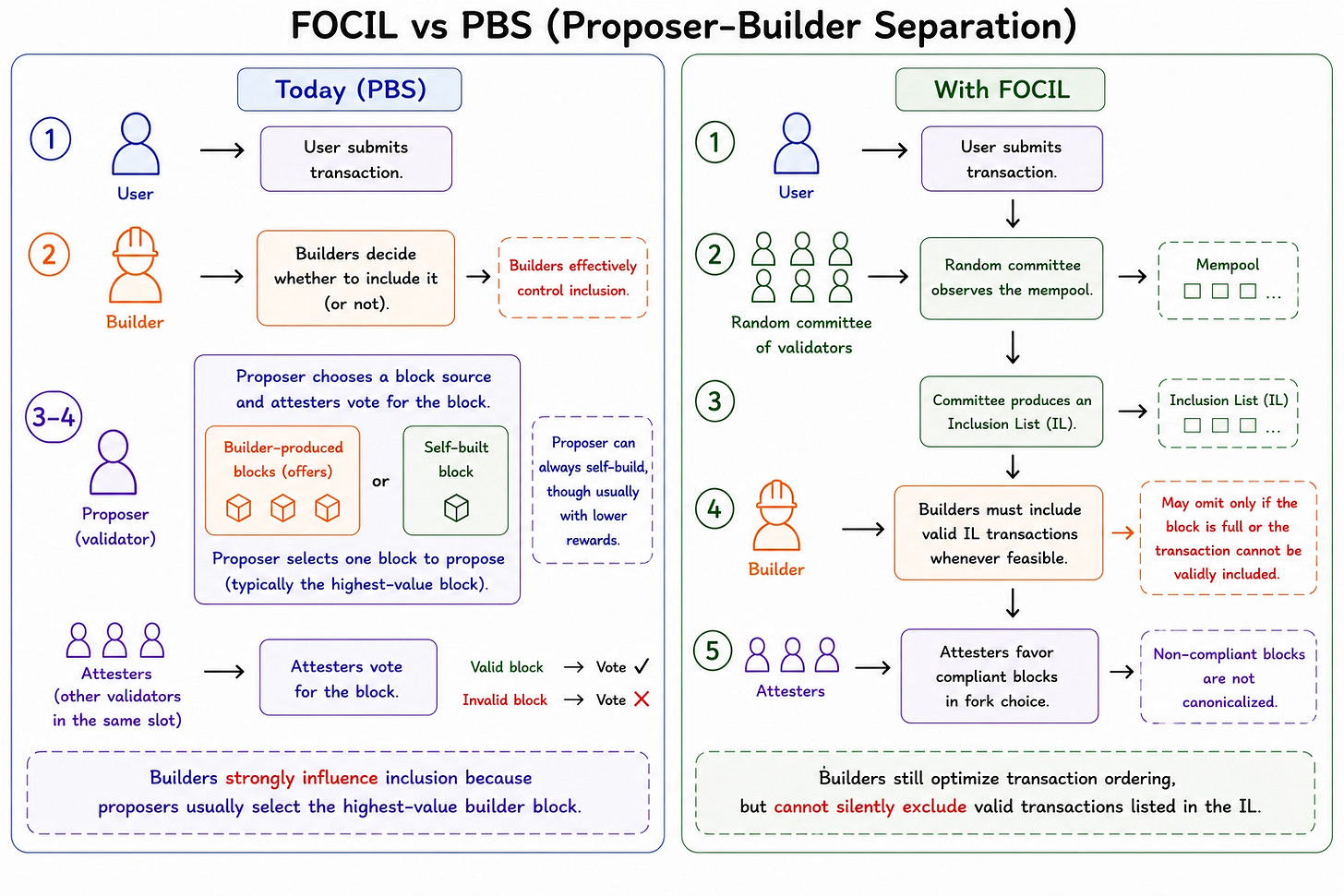
Today
Users submit transactions, but builders ultimately decide which transactions make it into a block.
Validators can only accept or reject the completed block, and while they can self-build, they typically choose builder blocks for higher rewards, effectively delegating inclusion decisions to builders.
With FOCIL
FOCIL introduces validator-generated inclusion lists.
Each slot, a randomly selected committee of validators observes the mempool and produces these lists. Builders must make a best effort to include these transactions. They may only omit if the block is full or a transaction cannot be validly included.
Builders still optimize ordering and capture MEV, but can no longer silently exclude valid flagged transactions.
What FOCIL Improves
FOCIL makes censorship significantly harder. Exclusion now requires coordination across both:
block builders
a rotating validator committee
This improvement works on multiple levels:
Technical: Builders can no longer unilaterally censor transactions
Geographic: Validators are globally distributed, reducing vulnerability to localized regulatory pressure
Philosophical: Inclusion becomes rule-based (protocol-enforced), not discretionary (builder-subjective)
Tradeoffs
FOCIL is not free:
More protocol complexity
Additional validator communication overhead
Ongoing research into incentives and edge cases
Interaction complexity with future PBS designs
The core question is not feasibility, but tradeoff: How much complexity is worth stronger censorship resistance guarantees?
Roadmap and Timeline
FOCIL was initially scoped for Glamsterdam (Ethereum’s next major fork, targeting 2026, centered on ePBS and Block-Level Access Lists). After debate over cross-layer complexity and schedule risk, it was pulled out.
FOCIL (EIP-7805) is now the consensus-layer headline of Hegotá, the fork following Glamsterdam, currently targeted for 2027, alongside account abstraction as a secondary feature.
Conclusion
PBS was a necessary step: separating block construction from consensus, reducing validator burden and supporting a decentralized validator set. But construction itself concentrated in a few builders.
FOCIL brings the validator set back in, strengthening their voice in what gets included.
Neutrality comes from diversity. When validators independently express their view of the mempool, it becomes significantly harder for any single actor to consistently exclude transactions.
Ethereum has long decentralized consensus. FOCIL extends that logic to inclusion.
Sources and further reading
Fork-Choice enforced Inclusion Lists (FOCIL): A simple committee-based inclusion list proposal - the original ethresear.ch design post by Thiery, Monnot, D’Amato, and Ma
EIP-7805: Fork-choice enforced Inclusion Lists (FOCIL) - the formal specification
meetfocil.eth.limo - a live implementation-progress tracker and plain-language property breakdown by Jihoon Song
Fork-Choice enforced Inclusion Lists (FOCIL) - Julian Ma, Devcon SEA
Checkpoint #9 (April 2026) - confirms FOCIL as the Hegotá headliner
Right of Audience: A Case for FOCIL - Sina Mahmoodi, Pop-X Berlin
Thanks for reading!
Best regards,
Riely & the Geode Labs team
Have thoughts on this issue? Reply or DM me - I read everything.
Want to support Local Ethereum? Reach out about sponsorships.

Riely
Riely is the Editor in Chief of Local Ethereum, covering Ethereum and crypto adoption stories from around the world. Based in Berlin, she covers stories from India, Argentina, Poland, Taiwan, Serbia, and beyond, with a focus on how decentralized technology intersects with local culture, economics, and politics.
Published June 25, 2026 · 3 min read
Local Ethereum
Enjoying the read? Get this in your inbox.
In-depth Ethereum ecosystem coverage: regional deep dives, monthly roundups, and global analysis. Twice a month, free.
Subscribe, it's free