Greetings! 👋
Ethereum is having a moment of reckoning, and quietly, a moment of clarity. The foundation is leaner and more opinionated. The roadmap is more concrete. Censorship resistance is being hardened at the protocol level. Privacy tooling is shipping. And across the Atlantic, regulators are finally writing the rules.
Bear markets have a way of filtering out the noise. And with AI making builders more productive than ever, there’s never been a better time to build.
Subscribe now
⚡ Highlights
1. The CLARITY Act Advances in Historic Bipartisan Vote
On May 14, the US Senate Banking Committee passed the Digital Asset Market Clarity Act in a 15-9 vote, the biggest procedural hurdle the bill has faced, and the first time a comprehensive crypto market structure bill has received meaningful Democratic support at the committee level.
CLARITY would give crypto its first proper legal framework in the US, clarifying which tokens are commodities vs securities, who regulates them, and giving DeFi activities explicit legal protection. More fundamentally, it would be the first time US law formally recognizes that decentralized networks are a different thing from companies, and should be regulated differently.
If passed, the implications are significant:
ETH and most major tokens would be classified as digital commodities, lifting years of SEC enforcement risk
DeFi builders and validators would get legal clarity to operate in the US
Institutions on the sidelines would have a clear on-ramp to enter the market
Developers and capital that moved offshore may return
Years of “regulate by lawsuit” replaced by an actual statutory framework
The road ahead: The bill still needs 60 Senate floor votes to clear a filibuster, meaning roughly 7 Democrats must cross over. The main obstacle is an ethics provision targeting government officials’ crypto conflicts of interest, a direct response to Trump and his family’s crypto ventures. No ethics deal, no 60 votes. If it doesn’t pass before August recess, the next realistic window may be 2030.
Further reading
2. CROPS: Feature or Bug?
The past few months have genuinely tested Ethereum’s community. At least nine senior EF departures in five months, including protocol leads Tim Beiko and Barnabé Monnot, and former co-ED Tomasz Stańczak. The exits followed the CROPS mandate: censorship resistance, open source, privacy, security, which many read as the EF stepping back from growth. ETH down ~30% YTD. Sentiment at a low.
Zoom out, and the picture looks different. This is the EF doing exactly what it said it would: ensure Ethereum becomes and stays a decentralized and resilient tool for self-sovereignty. Vitalik’s thesis is simple: a leaner, more opinionated foundation narrowly focused on CROPS: “one node, with a defined purpose, alongside other nodes.” Ethereum wins on credible neutrality. That trust compounds into network effects, and network effects are the moat that actually lasts.
The technical roadmap backs it up: provably bug-free code via AI-assisted formal verification, a consensus model resilient to 49% attackers that no other PoS chain can match, and censorship resistance baked into the protocol itself via FOCIL. The short-term pain of a leaner EF may be the price of long-term credibility, and credibility is the one thing competitors cannot copy.
Further reading:
🪐 Global Ecosystem Update
🔧 Scaling, UX & Hardness
Mapping the Strawmap: Ethereum’s Big Course Correction by Lucas Tcheyan (Galaxy): a comprehensive analysis of Ethereum’s L1 roadmap since the Merge: 10,000 TPS, post-quantum cryptography, sub-second finality, and default privacy across seven planned forks. The central open question: will demand materialize to match the capacity being built?
The Ethereum Foundation announced a new Protocol cluster, with Will Corcoran, Kev Wedderburn, and Fredrik as coordinators.
An Ethereum Working Group, including wallet developers, security firms, and the EF’s Trillion Dollar Security Initiative, launched an open standard to end blind signing, the structural flaw behind billions in user losses including the Bybit hack.
The Latency Cost of Censorship Resistance: a16z researchers prove that protocol-enforced inclusion carries an unavoidable minimum cost of 2 extra communication rounds. The tradeoff is worth it: censored transactions get a guaranteed inclusion bound instead of waiting indefinitely.
💸 DeFi, Stablecoins & Payments
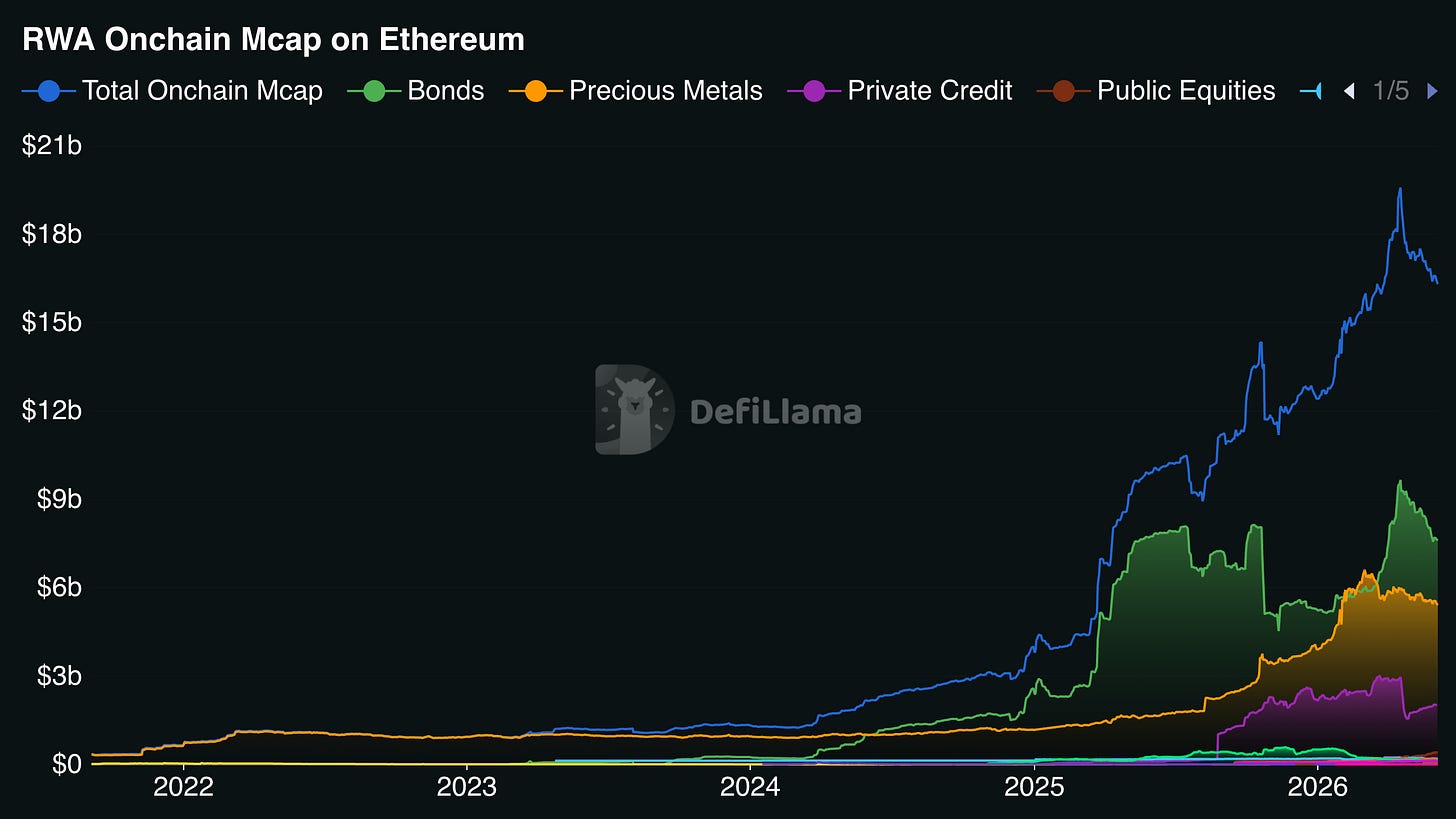
The Emerging Tokenization Stack: tokenization is graduating from theory to real market infrastructure. DTCC is piloting onchain securities issuance with 50+ firms, Bullish acquired transfer agent Equiniti, and Coinbase and Securitize are plugging tokenized assets into DeFi composability and propAMM liquidity.
JPMorgan Launches Tokenized Money Market Fund on Ethereum: JPMorgan launched JLTXX, its second tokenized Treasury fund on public Ethereum, seeded with $100M and designed to serve as eligible reserve collateral for stablecoin issuers under the GENIUS Act, the largest global bank to go live on a public blockchain.
Variational’s $50M Raise Reignites the RFQ vs CLOB Debate: RFQ models work best for long-tail and illiquid assets; CLOBs win on composability and price discovery. The market is heading toward a hybrid of both.
Are Stablecoins a Risky Form of Private Money? A rebuttal to the WSJ’s argument that stablecoins are inherently fragile; what actually matters is reserve quality, redemption rights, and transparency, not whether the issuer is a bank or a blockchain.
Why ‘Stablecoins’ Won’t Age Well: stability is now table stakes; the label has outlived its usefulness as the technology becomes foundational infrastructure for programmable, internet-native money.
Why Prediction Markets Matter: prediction markets aggregate dispersed information into real-time probability signals, and crypto makes them more transparent, scalable, and harder to game.
🔐 Privacy
Kohaku Wallet Update: Kassandra (EF) shares a candid thread on what Kohaku is actually building: an SDK that embeds Railgun, Tornado Cash, and Privacy Pools into wallets with a fully intermediary-free relay path via the ERC-4337 mempool (using EIP-7702). The v0.0.1-alpha.21 milestone for 4337 relaying is now live; Ambire is preparing an integration.
Announcing the Private Transfers Dashboard: PSE launches a public dashboard to benchmark private transfer protocols across the Ethereum ecosystem, bringing visibility to a space that has historically lacked shared metrics.
10 Privacy Features Ethereum Devs Want - All of Them Live on Aztec: Aztec responds to PSE’s user research on the top pain points in private transfers (slow proving, leaky deposit/withdraw flows, fragmented privacy sets, missing tooling) and walks through how each is already solved on Aztec today.
Social Recovery SDK: Design, Implementation and Learnings: PSE releases an open SDK letting developers add guardian-based wallet recovery to smart wallets, replacing seed phrase backups with programmable onchain policy.
🌍 Regional
UK Sets Out Vision on Tokenization and Stablecoins: the FCA and Bank of England laid out a wholesale markets tokenization roadmap, committed to final stablecoin rules by end of 2026, and softened their stance on stablecoin issuance.
European Commission Launches MiCA Review: less than 18 months after MiCA came into full effect, the EU is already consulting on whether the framework remains fit for purpose , with key questions around stablecoin interest prohibition, DeFi and staking coverage, equivalence for global issuers, and whether tokenized financial instruments should fall under MiCA or existing securities law. Feedback open until August 31.
muShanghai: The Mu’s first mainland China pop-up city (May 10 – Jun 6) brought together 2000+ domestic and international builders across Web3, AI, and hardware, spotlighting China’s surging tech ecosystems from ClawCon’s China debut and homegrown LLMs during AI Week, to “Physical AI” and humanoid robots during Robotics Week.
📊 Ecosystem Data
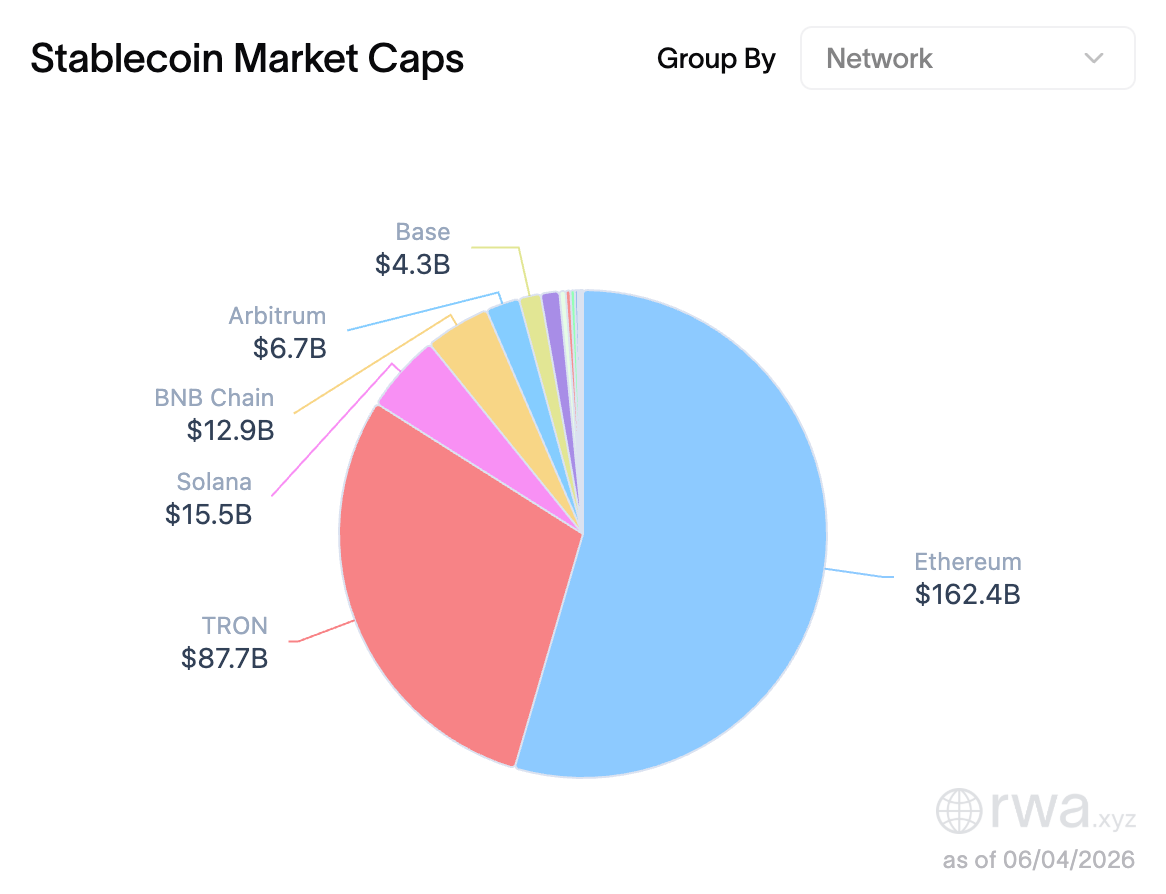
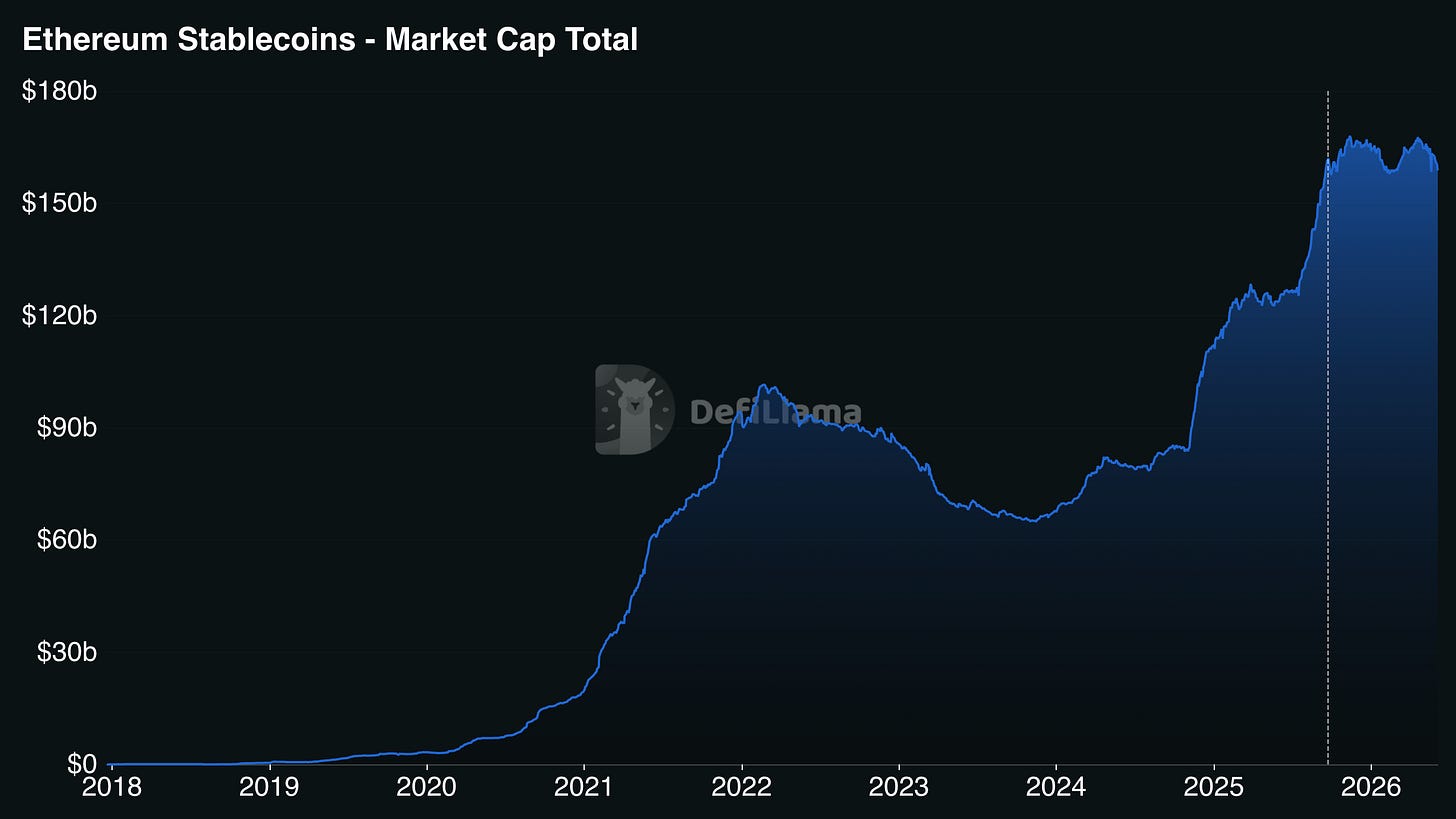
Stablecoin Market Cap on Ethereum: $162.4B (as at 4th Jun, 2026)
Ethereum mainnet holds $162.4B in stablecoin market cap, leading the largest of any network, ahead of TRON ($87.7B), Solana ($15.5B), and BNB Chain ($12.9B).
cr: https://app.rwa.xyz/stablecoins