Greetings! 👋
September brought a regulatory opening for tokenized stocks on public chains, a tighter Ethereum roadmap built around quantum resistance, and stablecoin rewards that are getting less generous. Let’s dig in.
Greetings! 👋
September brought a regulatory opening for tokenized stocks on public chains, a tighter Ethereum roadmap built around quantum resistance, and stablecoin rewards that are getting less generous. Let’s dig in.
On September 15, the CLARITY Act stalled in the Senate after its cloture vote failed 49-50. Two days later, the SEC moved on its own.
What the SEC allowed
Its Innovation Exemption lets a new kind of venue trade tokenized US stocks through permissioned AMM pools for five years, without registering as an exchange. The venue controls who trades, but its smart contracts must be public and run on a permissionless ledger. Liquidity providers are also exempt from dealer registration, so the pools can actually fill.
The Ethereum angle
The SEC could have required a private chain with known operators. It chose public ones, with access control at the venue. That favors where the market already is: Ethereum and its L2s hold $1.21B in tokenized stocks, more than any single chain, and a week later Aave V4 began accepting them as collateral.
What it doesn’t cover
DEXs. Commissioner Peirce noted that the order is not about DeFi, and that investors don’t need an exemption to trade peer to peer through permissionless contracts. Whether the DEXs themselves count as exchanges is still open; a16z and the DeFi Education Fund asked for a safe harbor three days earlier.
Why it matters
The exemption is temporary while the SEC considers further action. That makes the next five years a test of whether public chains can carry real equity markets, weekends included.
Further reading
The SEC should clarify how exchange rules apply to blockchains, a16z crypto
The SEC Has a New Theory for Crypto. Now It Has to Make It Work, GSR
SEC Issues “Innovation Exemption” to Facilitate the Trading of Tokenized NMS Stock, SEC
On September 7, the EF Protocol cluster published a single tier list for all 62 EIPs proposed for Hegotá, its first unified view across teams. About 60 researchers and engineers cast 397 grades: 2 must-ship, 15 expected to ship and 28 declined, each with a written reason.
Why so little made the cut
The cluster targets a quantum-resistant L1 by December 2029, which means five forks after Glamsterdam at roughly one every seven months. So Hegotá’s consensus layer is FOCIL and little else. On the execution side, Frame Transactions give accounts a route off quantum-vulnerable keys.
The pushback
Obol’s Oisin Kyne argued the list underweights validator concentration, citing the declined EIP-7716; the cluster revised its note a day later but kept the grade. The bigger test was EIP-8363, the tapered issuance burn. After 200+ comments on Ethereum Magicians, its authors withdrew it from Hegotá and committed to a dedicated issuance process, with Lido offering to help steer it.
Why it matters
For builders, Hegotá is the first step toward a quantum-resistant Ethereum by 2029: Frames give accounts a route off today’s vulnerable keys, a proposal under consideration would stop new validators from using old BLS withdrawal credentials, and FOCIL strengthens inclusion guarantees along the way.
Further reading
The Hegotá EIP Opinion Post and Tier List, EF Protocol Cluster
Current and Emerging Priorities, EF Protocol Cluster
The frame: Hegotá may be Ethereum’s last “normal” fork. In The Cryptographic World Computer, Vitalik argues that Ethereum’s core machinery is being rebuilt around cryptography: verification, consensus and block building, with light clients able to check far more. After Hegotá, recursive STARKs, formal verification and quantum safety become the main story. For builders, parallelizable or pre-aggregated work should get cheaper than one large serial transaction.
Sepolia activates Glamsterdam on October 6, with a 200M gas limit, up from 60M. Two changes make the jump possible: block-level access lists let clients validate in parallel, and ePBS gives validators more of each slot to check the block.
Prysm and Teku now support Ethereum’s Fast Confirmation Rule (FCR), whose spec is formally verified and covered by the EF bug bounty. Chainlink CCIP 2.0 is the first major production integration, offering an opt-in fast path that confirms eligible transactions in ~12–24s instead of ~13m, without changing Ethereum’s default finality.
Core devs move Quick Slots (EIP-8198) to CFI for Hegotá. Clients first remove hardcoded 12-second assumptions, then decide on 10 seconds after testing. DEXes and tokenized-asset issuers surveyed by Ethlabs agree: every second between a signed quote and a confirmed trade is price risk. With FOCIL, 10-second slots mean six inclusion chances per minute instead of five.
Ethlabs machine-verifies decoupled consensus in Lean. It’s a longer-term path to faster finality: a 1,000-node testbed showed ~4x improvement, and Ethlabs mapped three compounding paths to 50%+ lower latency.
Base and Ethereum split on account abstraction. Base plans to ship its own standard (EIP-8130) this year, while Ethereum’s, Frame Transactions (EIP-8141), is a Hegotá headliner. Ethlabs is pushing to unify them on Frame Tx, which also opens a path to post-quantum signatures.
Ethereum Economic Zone demos atomic L1↔L2 swaps. In a demo shared by Gnosis co-founder Martin Köppelmann, a CoW Swap trade settled on an L2 using L1 liquidity, with bridging out and back in one atomic step.
Stablecoin yield gets less generous. Ethena cut USDe incentives to zero after spending about $750M, and Coinbase now pays USDC rewards only to subscribers.
Open Standard launches OUSD on Ethereum, Base, Solana and Tempo. Stablecoin tech is settled; the fight is over who keeps the reserve yield. OUSD shares it with the businesses that integrate it, in proportion to the supply and activity they drive. Issued by Stripe’s Bridge, it mints and redeems 1:1 at no cost.
Tokenized stocks become DeFi collateral. Aave V4 and Morpho now let non-US users borrow USDC against Coinbase tokenized stocks like AAPL and NVDA on Base. Aave’s price feeds hold their last price over weekends, when the underlying market is closed. Early demand is small: Morpho’s markets drew about $104K of collateral at launch.
DeFi’s 2020 class splits. Balancer voted to wind down, and Abracadabra has proposed shutting down MIM. Meanwhile Uniswap and Aave keep shipping, and Morpho has passed $14B in deposits, with Coinbase and Robinhood among its distribution partners. The contrast points to the same few advantages: security, sustainable economics, distribution, and a product people use.
Fixed-rate lending gets another shot. Coinbase launched fixed-rate USDC loans against bitcoin on Base, powered by Morpho Midnight; its variable-rate Morpho loans already exceed $1.4B. Earlier fixed-rate protocols like Yield Protocol and Notional stayed niche. Morpho’s bet is that Coinbase’s distribution can do what product design alone could not.
SEC staff say some liquid staking tokens may be commodities. Under the September 25 FAQs, a staking receipt token issued by a protocol-based liquid staking provider may be classified as a digital commodity. It’s a positive signal for LSTs, though staff guidance has no legal force.
EF and the Open Anonymity Project launch zkAPI on mainnet. Based on a design by Vitalik and Davide Crapis, it lets you pay for AI and other metered APIs without tying usage to a billing identity: deposit once, then spend with zero-knowledge proofs. It works with any OpenAI- or Ollama-compatible app, though IP addresses and prompt content can still give you away.
zk.money relaunches on Aztec. The private payments wallet is back as a new product on Ethereum’s privacy L2: pay people by tag, while amounts, balances and history stay private.
a16z releases Lattice Jolt, a post-quantum zkVM that a16z says proves and verifies 2-3x faster than the version it replaces.
Bitget loses about $388M in 2026’s largest hack. Attackers exploited a third-party security product to obtain internal credentials, then sent fraudulent withdrawal commands that bypassed risk controls, without touching private keys. Bitget suspects North Korea and says its protection fund covers the loss.
MetaMask investigates a security incident affecting part of its infrastructure and has exited its staking validators as a precaution. It says there is no sign that wallets or customer funds were affected.
Worth reading: When Civilization Escapes the Human. LambdaClass founder Federico Carrone, whose team builds the ethrex client, on what happens to purpose when AI no longer needs us.
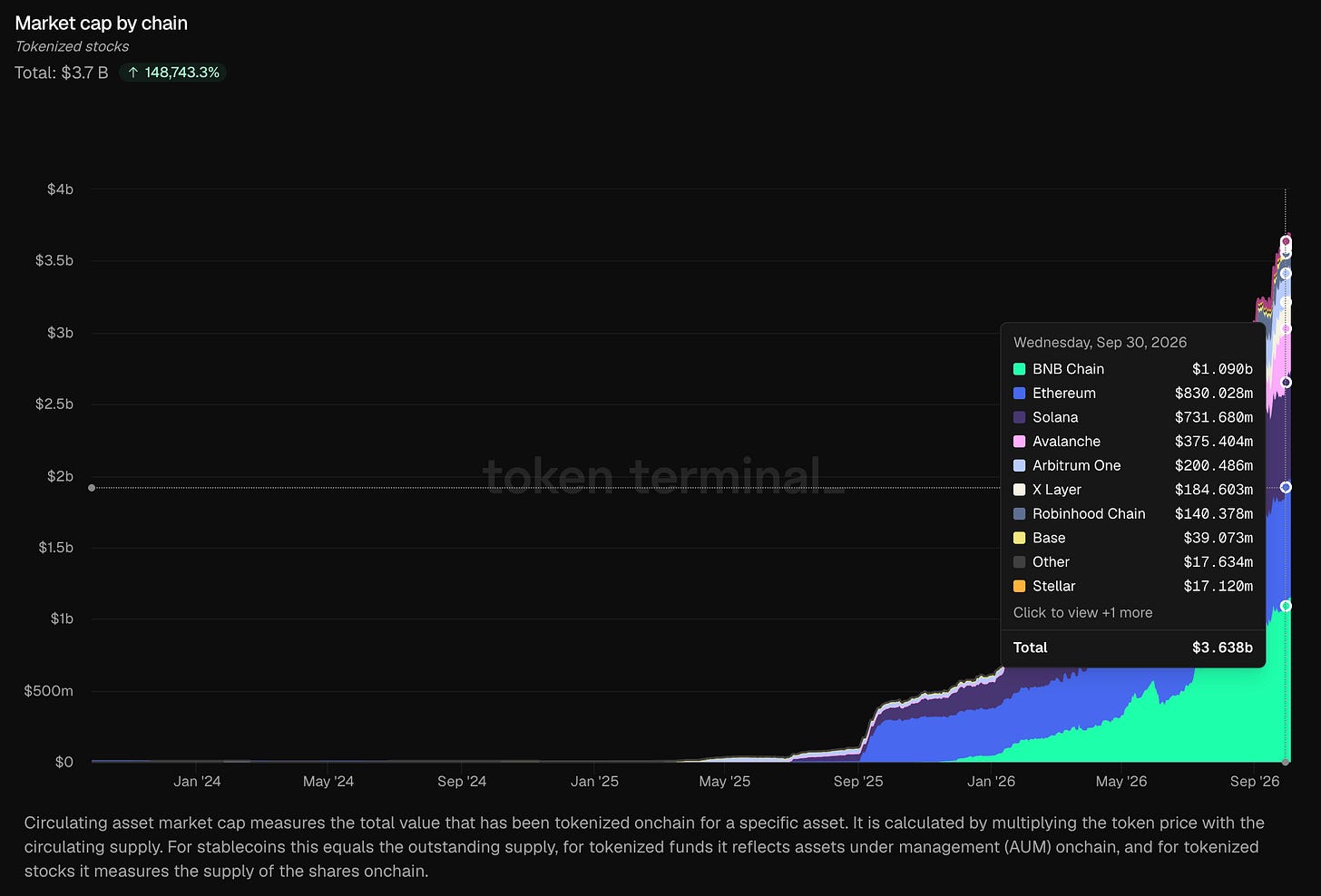
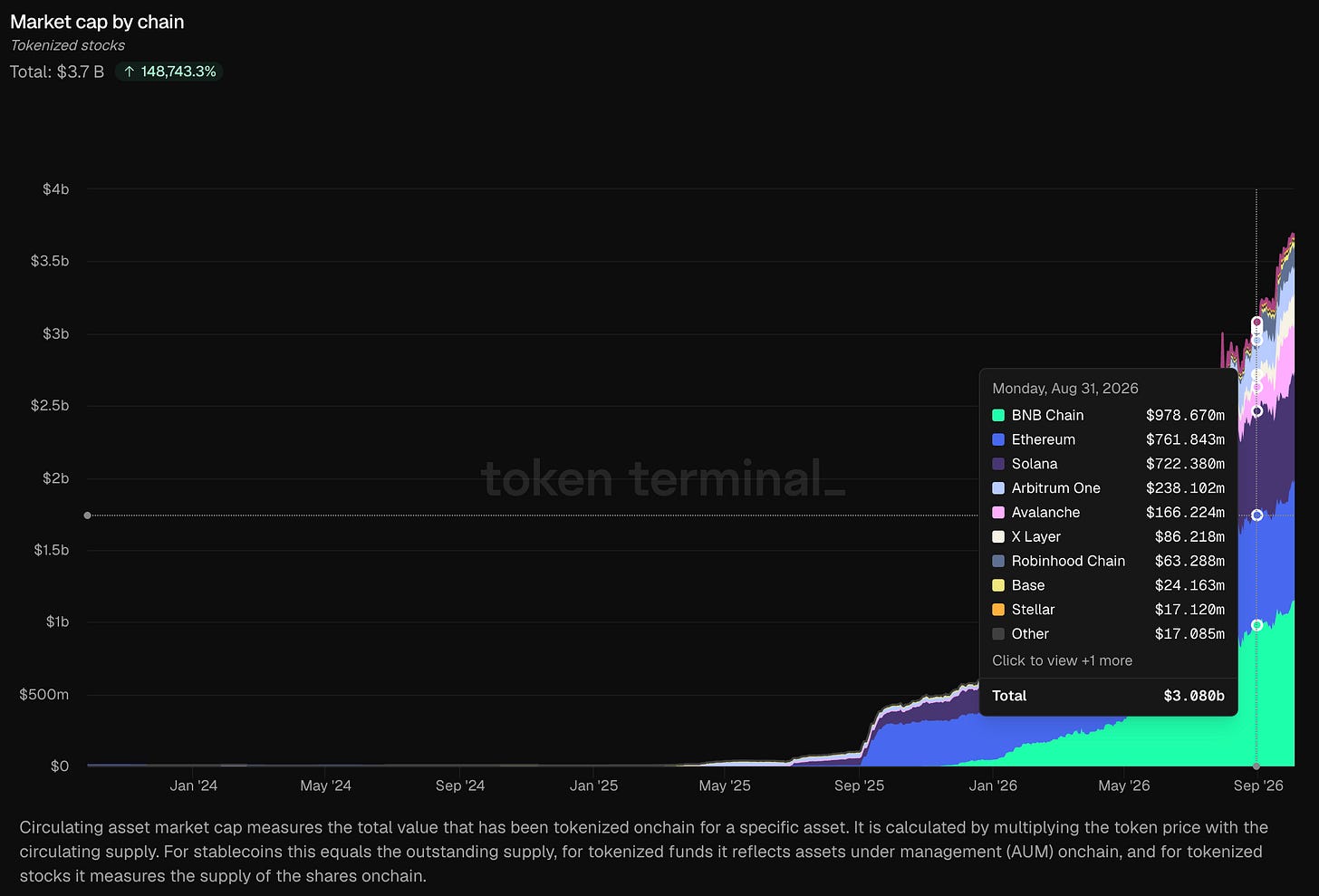
1.Tokenized stocks on Ethereum and its L2s: $1.23B (+11.7% MoM) (as of Sep 30, 2026)
Ethereum and its L2s hold $1.23B in tokenized stocks, more than any other chain. Growth came from Robinhood Chain (+122%), Base (+62%) and mainnet (+9%), while Arbitrum fell 16%.
Who holds them? Arrakis estimates that 97% of Ondo’s Ethereum holdings sit in self-custodial wallets, while 83% of Binance’s bStocks sit on Binance. It classifies only about 14% of onchain trading as organic, with over half looking like rewards farming or automated trading.
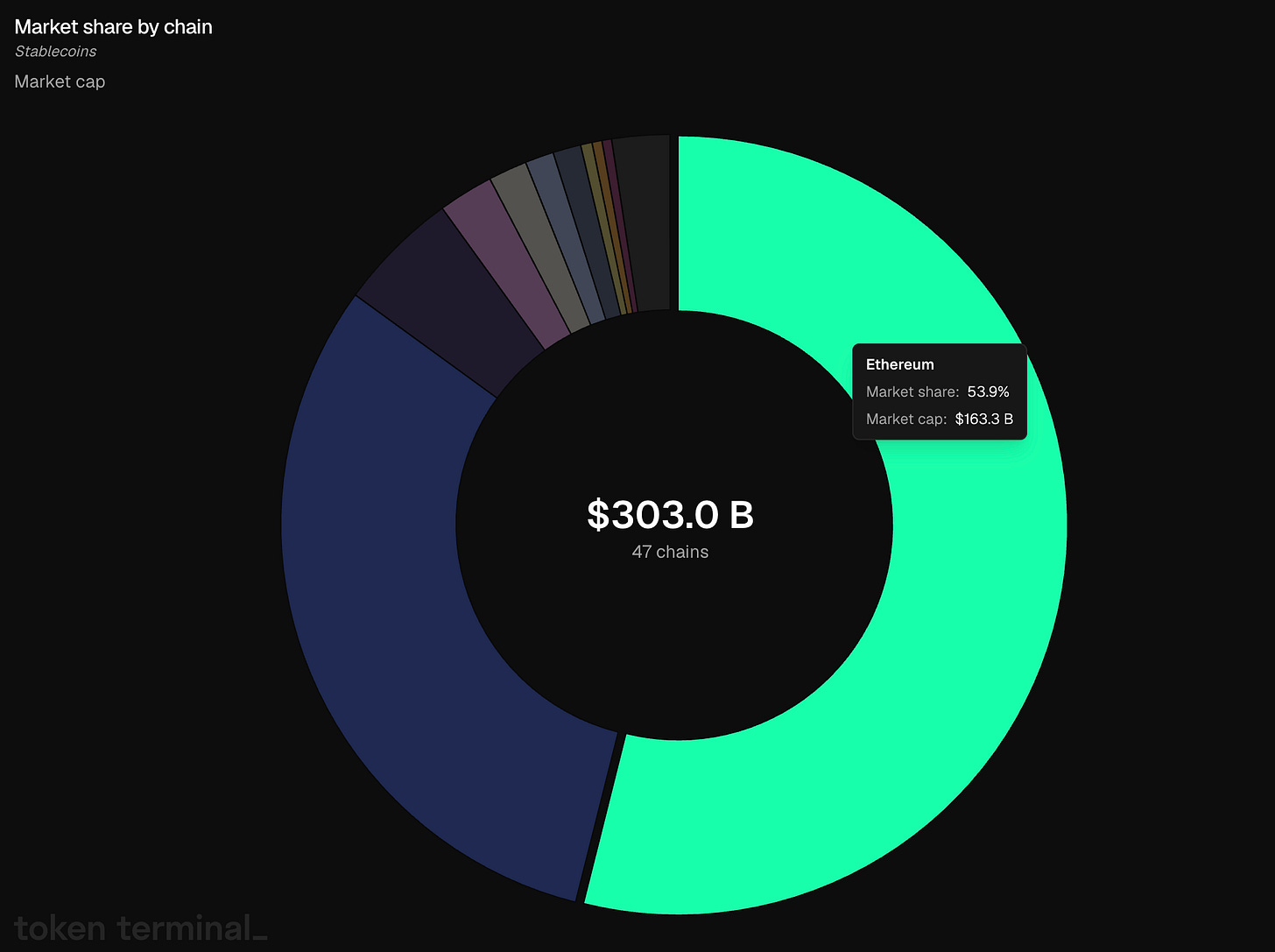
2.Stablecoin market share on Ethereum: 53.9% of $303B (as of Sep 30, 2026)
Ethereum mainnet alone holds more stablecoins than Tron ($93.9B), Solana ($14.8B) and HyperEVM ($7.0B) combined. Supply held steady at about $163B through August and September.
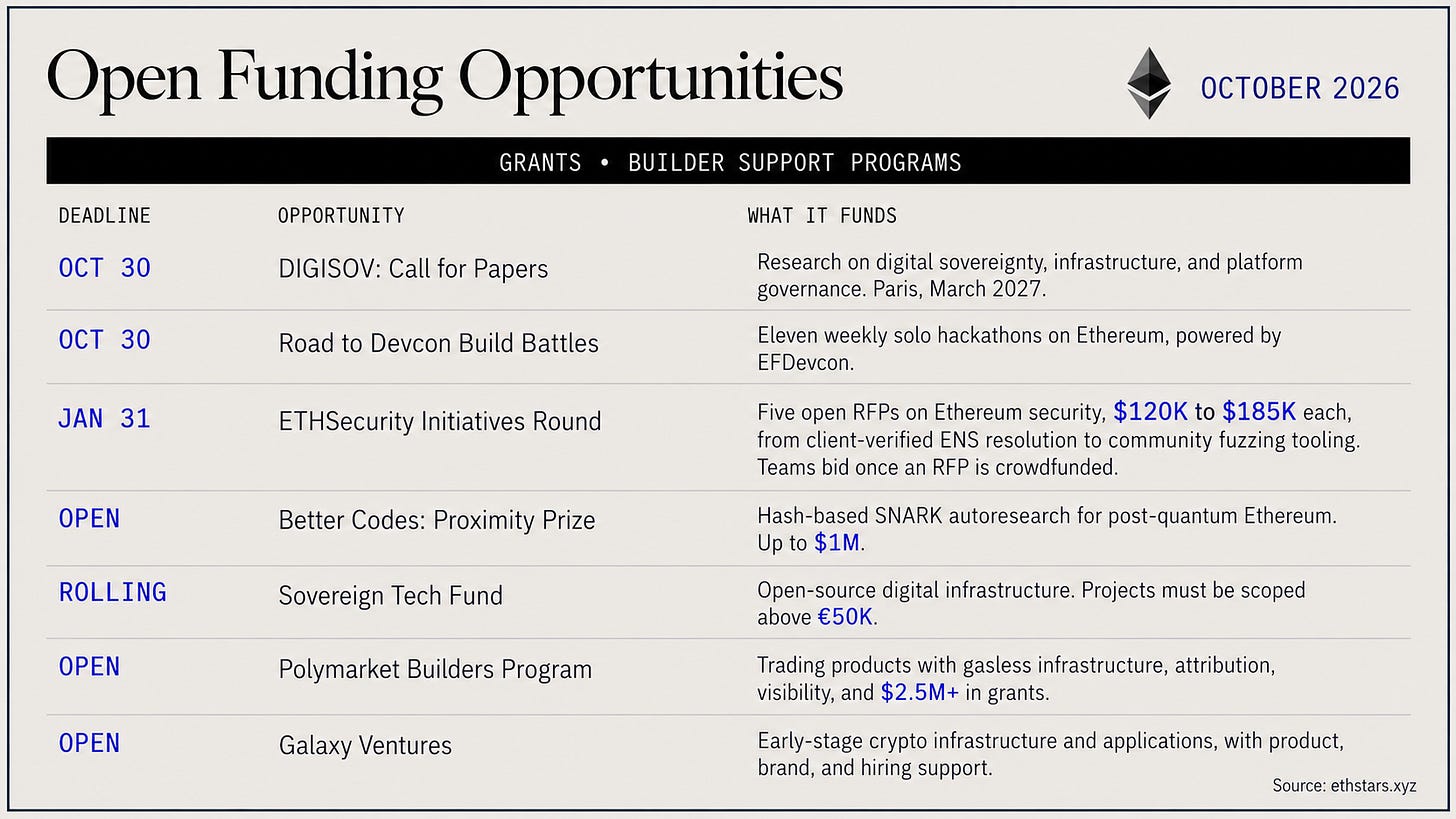
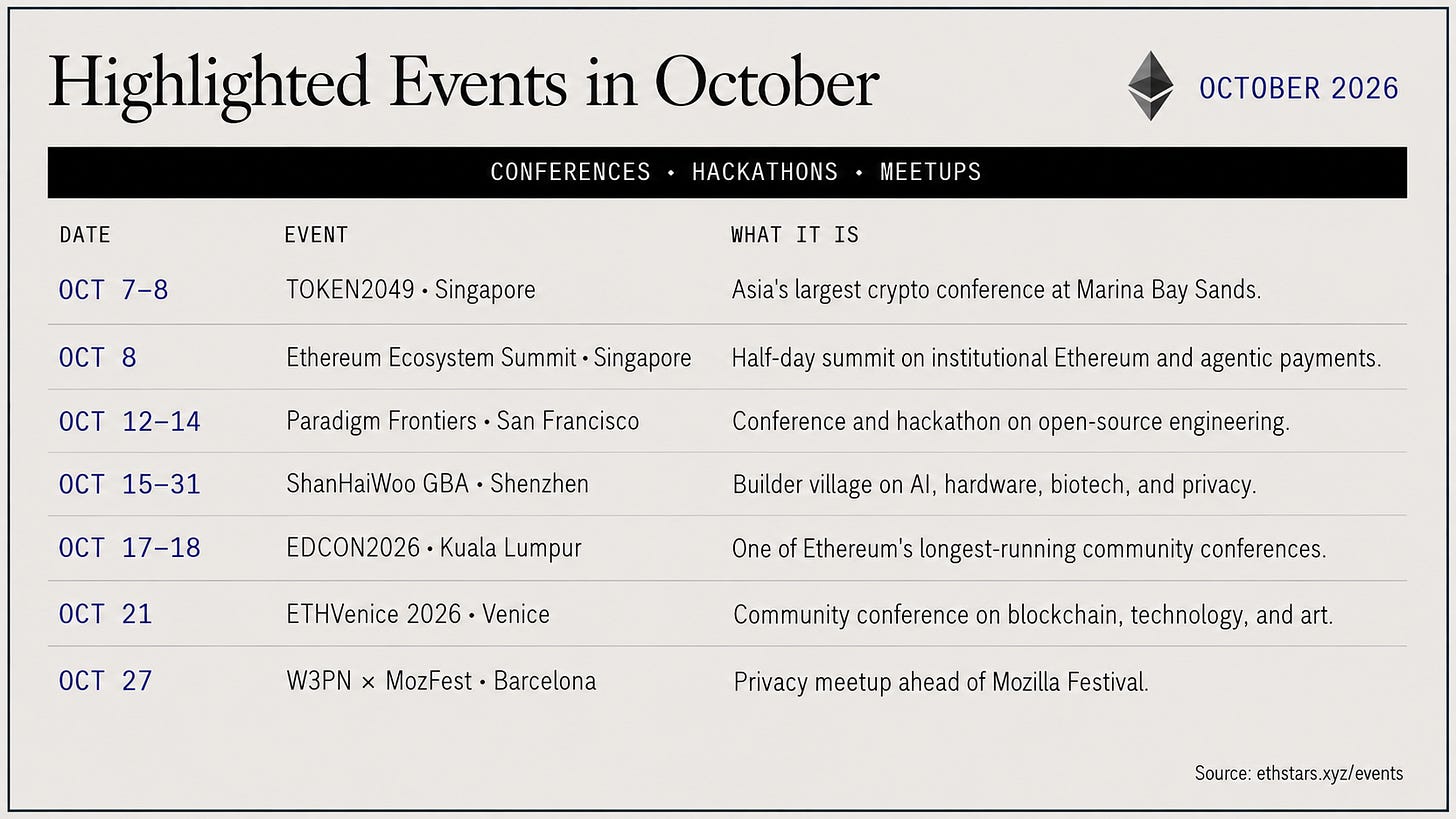
What’s the most genuinely new thing you’ve seen in 2026? Hit reply and tell us.
Privacy is a human right. Stay safe!
Riely & Geode Labs
Have thoughts on this issue? Reply or DM me - I read everything.
Want to support Local Ethereum? Reach out about sponsorships.
Local Ethereum
Writer at Local Ethereum, covering Ethereum adoption from a local, ground-up perspective.
Published October 7, 2026 · 7 min read
Local Ethereum
In-depth Ethereum ecosystem coverage: regional deep dives, monthly roundups, and global analysis. Twice a month, free.
Subscribe, it's free