
Greetings! 👋
Eleven years, zero downtime: Ethereum turned 11 in July. The Clarity Act reached the one-yard line, and Morpho took a swing at DeFi’s oldest unsolved problem. Let’s dig in.
Greetings! 👋
Eleven years, zero downtime: Ethereum turned 11 in July. The Clarity Act reached the one-yard line, and Morpho took a swing at DeFi’s oldest unsolved problem. Let’s dig in.
On July 30, Ethereum marked 11 years since the Frontier genesis block. Since mainnet launch, Ethereum has never experienced a prolonged, global halt in block production. It continued operating through the DAO crisis, the Merge, and multiple bull and bear cycles. Today, over 40 million staked ETH, roughly one-third of the total supply, secures the network, which settles more than half of all stablecoin supply and holds the largest share of onchain RWAs.
The ecosystem itself is also evolving. More independent teams including EthLabs, EthSystems, Ethereum Institutional, Argot Collective, Etherealize, Geode Labs and others, are taking responsibility for different parts of Ethereum’s future while collaborating with the EF and the wider ecosystem. The protocol is moving forward too: the gas limit doubled to 60M in 2025, with 100M+ gas limits and post-quantum readiness ahead. Glamsterdam is targeted for H2 2026, while work on Hegotá and shorter slot times continues.
Why it matters: Eleven years of resilience, and development is becoming as distributed as the network itself: independent teams coordinating in the open through the EIP process and All Core Devs. A broader foundation for whatever comes next.
Further reading:
Ethereum enters its second decade - Margaux Nijkerk (CoinDesk)
Ethereum at 11: From the Genesis Block to Glamsterdam - Everstake
The crypto industry’s top legislative priority came down to the wire in July. Senate Republicans released a 616-page combined draft of the Digital Asset Market Clarity Act, merging the Banking and Agriculture Committee texts. The core framework already passed the House 294-134 last July: the CFTC takes spot markets for digital commodities like BTC and ETH, the SEC keeps investment contracts. The draft also shields noncustodial developers from money transmitter registration and preserves self-custody rights.
The Senate holdup centers on ethics: whether a sitting President who made over $1B from crypto in a single year can be meaningfully constrained by the same bill. Democrats rejected the proposed ethics division on three grounds: enforcement sits exclusively with the DOJ, it doesn’t reach existing ventures, and it sunsets the day Trump leaves office. Late in the month came a breakthrough. The White House agreed to a negotiated ethics package, and Treasury Secretary Scott Bessent said Congress was at the “one-yard line.” Then the clock ran out before the August recess.
Why it matters: the bill needs roughly 7 to 10 crossover Democrats to clear cloture, and the same 7 who spent the past year negotiating are the ones who rejected the new ethics terms. Trump’s late agreement to the ethics rules may change that math. The next window is September, which will be dominated by government funding fights and midterm politics. For the industry, this remains the closest a comprehensive market structure bill has ever come to passage.
Further reading:
The Clarity Act: what happened and what’s next - Renée Barton (Crypto for Innovation)
Why the Clarity Act - Marc Andreessen & Chris Dixon (a16z)
CLARITY’s Combined Text Is Here. Now It Needs Votes - Alex Thorn (Galaxy)
The EF’s Protocol cluster published its first monthly all-Protocol update: introducing a new team-by-team transparency format following the reorg and a clearer view of Protocol priorities. From keeping mainnet safe to shipping Glamsterdam and Hegotá, while advancing long-term research in fast finality, privacy, post-quantum security, state, and zkEVM. The headline: Glamsterdam remains on track for a Q4 mainnet, with Devnet-7 surviving heavy chaos testing and a public, spec-frozen Devnet-8 (Platåberget) imminent.
EthLabs is proposing faster slots for Hegotá: 12s → 10s. The proposal also makes slot time a protocol parameter, paying a one-time engineering cost that enables further reductions in future forks. Faster slots improve UX through quicker transaction confirmations, reduce oracle and price staleness, and strengthen censorship resistance.
Morpho launched Midnight, its first fixed-rate, fixed-term lending protocol. DeFi lending is still priced like overnight money through utilization-based rates, while previous fixed-rate protocols struggled to achieve deep liquidity. Midnight’s answer: fixed-rate offers no longer require idle capital, and a vault adapter lets the billions managed by Morpho’s curators quote fixed rates directly. If the yield curve becomes liquid, it could unlock interest-rate derivatives and open DeFi to traditional debt markets worth hundreds of trillions of dollars.
Gauntlet raises $125M from SBI Holdings, one of the largest raises ever for a DeFi risk and curation protocol. The signal: the curator layer, deciding where capital goes, what collateral is accepted, how exposures are capped, is becoming its own category of onchain asset management. Gauntlet now curates over $1.5B across Morpho, Kamino, Aera, and Symbiotic.
TradFi doesn’t want DeFi: it wants blockchains. a16zcrypto argues that institutions are selectively adopting the primitives that fit their needs (atomic settlement, programmable money, shared ledgers) while leaving behind open access and pseudonymity. The result: a new category of programmable financial infrastructure, with open networks remaining the source of future financial innovation.
Blockchain makes FX cheaper, but liquidity isn’t free. Enterprise Onchain breaks down a €10M cross-border payment: the on-chain leg takes seconds, but FX liquidity, compliance, and payout still set the end-to-end price. The real gain is capital efficiency: faster settlement lets the same capital fund more payments. The prediction: within 24 months, competition moves from confirmation time to corridor quality. The same pattern as our Philippines deep dive: on-chain is cheap, off-ramps are where the real costs sit.
Web3Privacy Now published the Ethereum Privacy Ecosystem Mapping 2026, covering the full landscape from advocacy and applications to identity, infrastructure, research, and protocol development.
The surviving crypto VCs raise $5.7B, with broader mandates. Paradigm closed a $1.2B fourth fund, joining a16z ($2.2B), Haun ($1B), Framework ($400M), Variant ($222M), and Dragonfly ($650M): evidence that institutional appetite for crypto hasn’t disappeared. Nearly every major fund is now positioning at the intersection of AI agents and onchain finance.
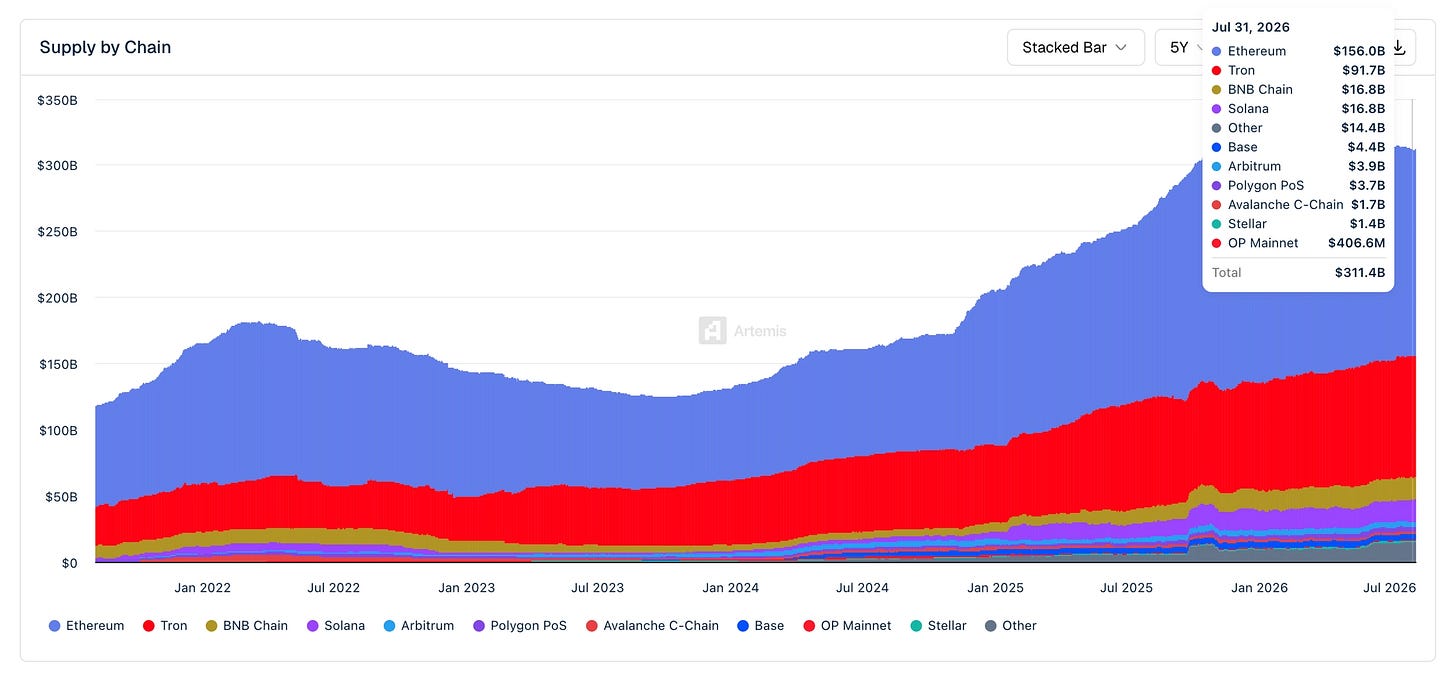
1. Stablecoin supply on Ethereum: $156.0B (-4.8% MoM) (as of Jul 31, 2026)
Still ~50% of the $311B onchain market, more than Tron ($92B), BNB ($17B), and Solana ($17B) combined. Goldman Sachs estimates two-thirds of stablecoin supply sits in emerging markets, where onchain dollars are savings, not trading chips.
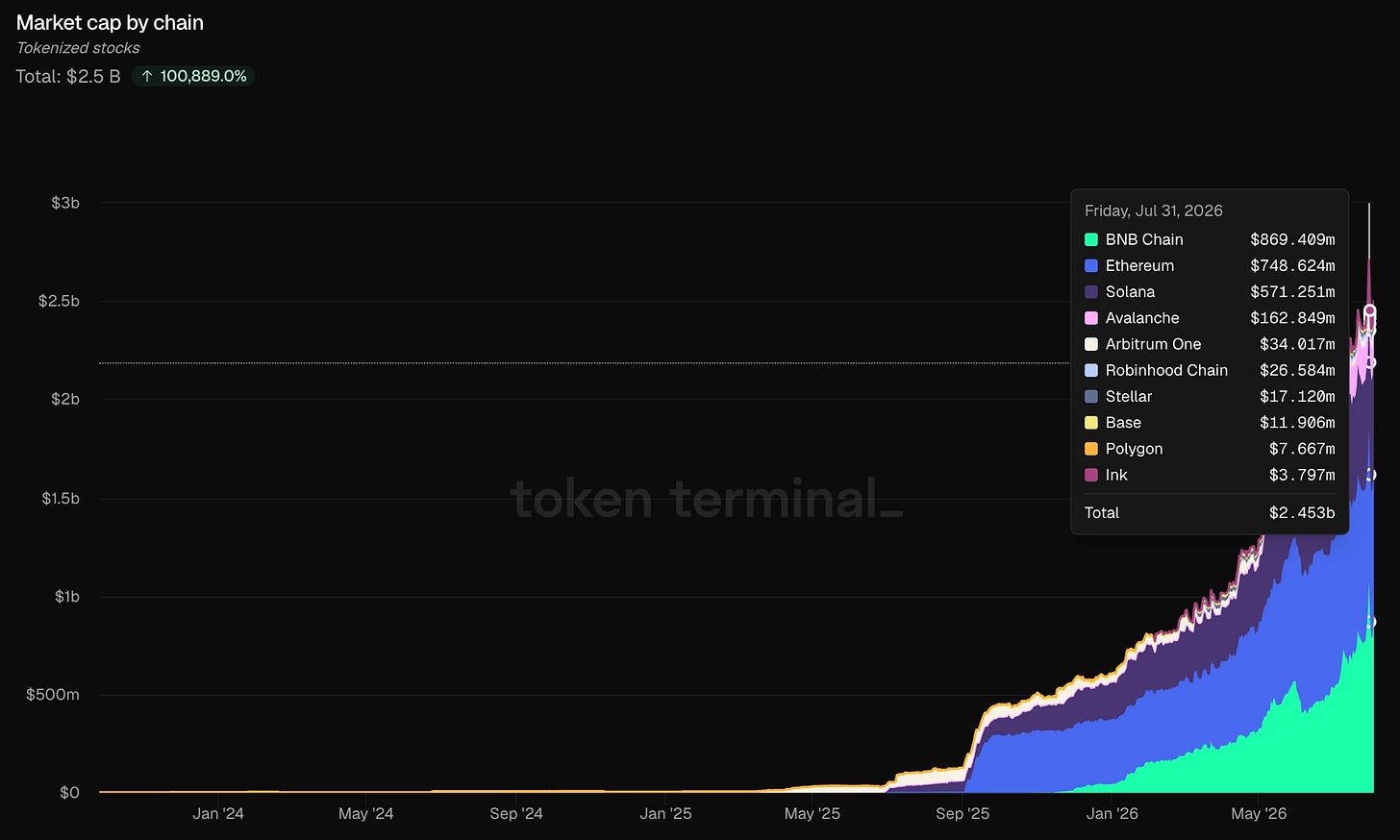
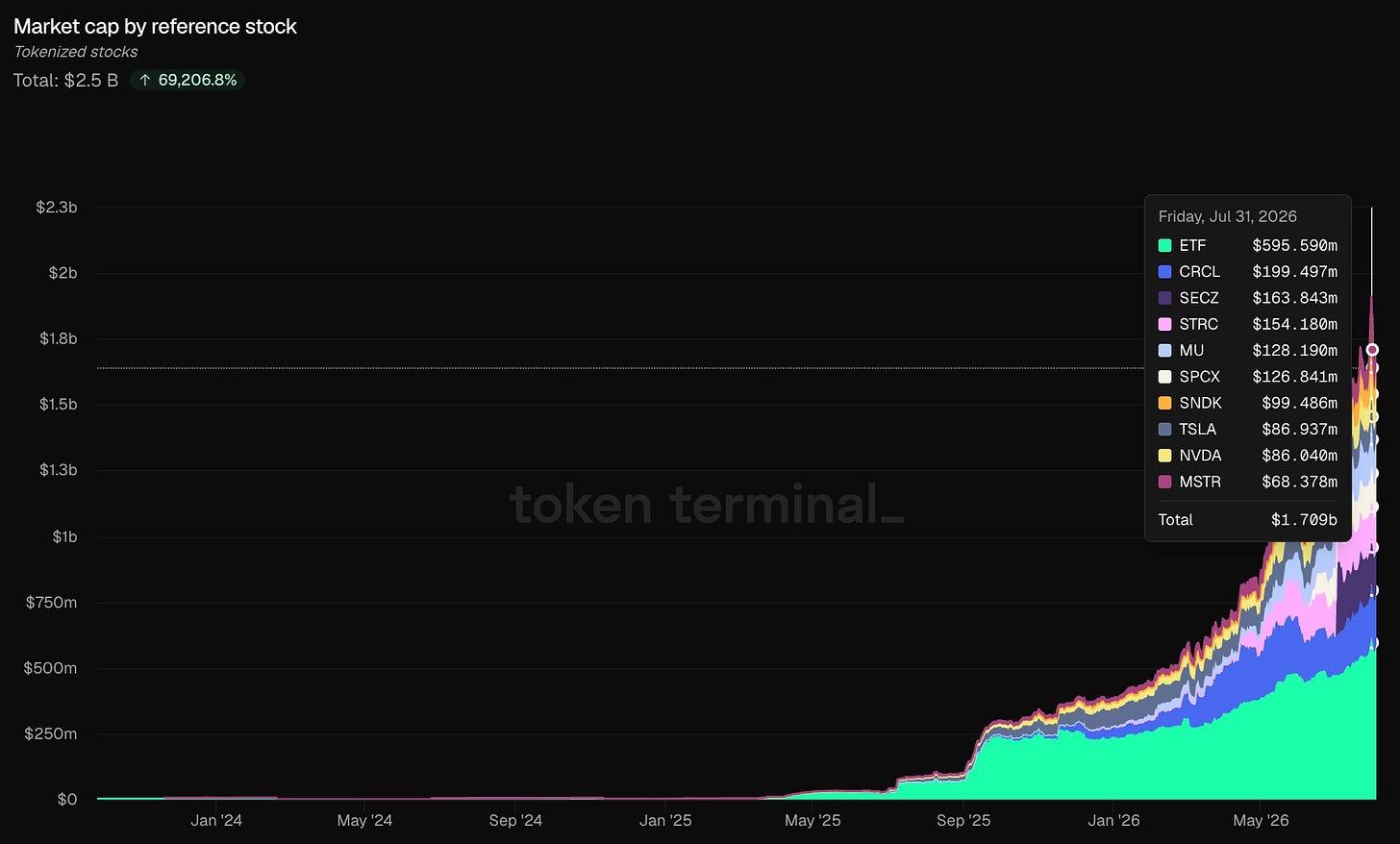
2. Tokenized stocks on Ethereum: $748.6M (flat MoM) (as of Jul 31, 2026)
The overall market jumped 50% to $2.45B. ETFs lead at $596M, and AI and chip stocks went from 0.3% to 15.5% of the market in a year.
Crecimiento Startup World Cup: startup competition in Buenos Aires (Aug 21), open to Web3, AI, and beyond. Apply by Aug 19.
Aleph Hackathon: two-day global hackathon by Crecimiento (Aug 22-23), online and across 30+ IRL chapters in Latin America and Africa. Free, all skill levels. Apply.
Uniswap Foundation Grants: funding for ecosystem, research, security, and governance work strengthening Uniswap and DeFi. Apply.
Blockchain and Distributed Ledger Track at COSCUP 2026, Taipei, Aug 8–9. 16 sessions on ZK proofs, bridge security, and onchain AI agents.
ETH Belgrade, Belgrade, Aug 26–27. Conference and hackathon in the Balkans, part of Belgrade Blockchain Week.
Cypherpunk Week, Amsterdam, Aug 31-Sep 6. A week of independent events, workshops, meetups, and hacker houses built around cypherpunk values.
Find more Ethereum events on the Ethereum Event List!
Eleven years in, still just getting started. Thanks for reading. 🥤
Riely and the Geode Labs
Have thoughts on this issue? Reply or DM me - I read everything.
Want to support Local Ethereum? Reach out about sponsorships.

Riely
Riely is the Editor in Chief of Local Ethereum, covering Ethereum and crypto adoption stories from around the world. Based in Berlin, she covers stories from India, Argentina, Poland, Taiwan, Serbia, and beyond, with a focus on how decentralized technology intersects with local culture, economics, and politics.
Published August 5, 2026 · 6 min read
Local Ethereum
In-depth Ethereum ecosystem coverage: regional deep dives, monthly roundups, and global analysis. Twice a month, free.
Subscribe, it's free